

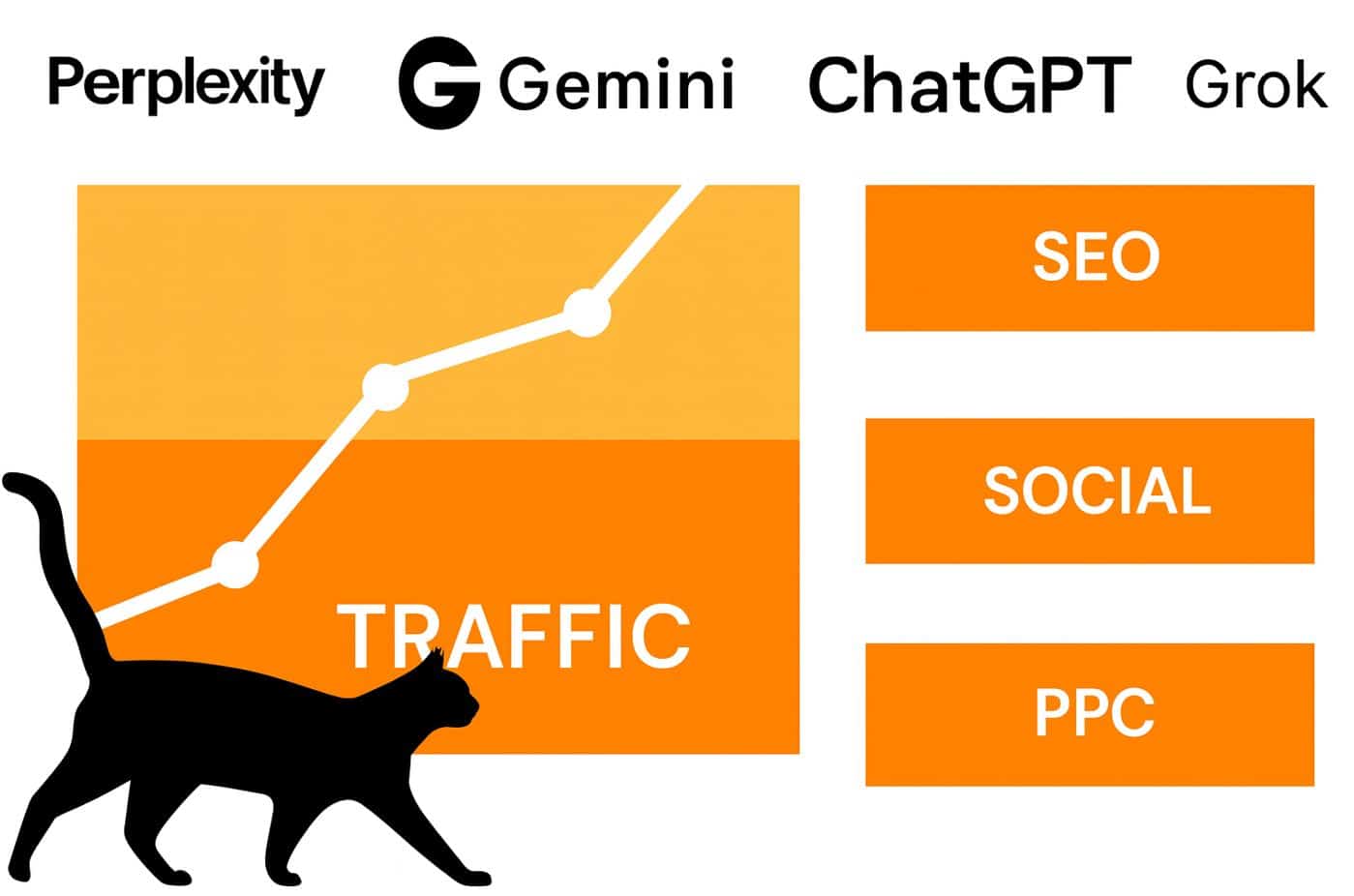
2026, SEO is no longer the same, and our SEO agency in Montreal becomes a AEO agency, as our expertise expands. A few figures to whet your appetite:
ChatGPT now handles more than 2.5 billion queries per day and exceeds one billion weekly active users, (yes, billion), a figure that, in some segments (especially 18-34 year olds), far exceeds that of Google. Perplexity, on the other hand, continues to grow by 25% per month and is becoming the daily reflex of hundreds of thousands of Quebec professionals and consumers who want accurate, sourced and instant answers.
En décembre 2025, les chiffres de Seer Interactive, sur 25,1 millions d’impressions organiques entre juin 2024 et septembre 2025, révèlent que le CTR organique s’effondre de 65% (de 1,76% à 0,61%) sur les requêtes où Google affiche un AI Overview. Le CTR payé s’effondre de 68% sur ces mêmes requêtes.
Cette diminution est comparable au Québec où Google présente l’AI Overview sur 58% des recherches desktop et 71% mobile.
queriesGrowthcitationsourceStudies
| Indicator | Statistics (end of 2025) |
|---|---|
| ChatGPT | > 2.5 billion / day |
| Perplexity | +25% / month |
| AI Overview Google | 58% desktop / 71% mobile (QUEBEC) |
| Fall CTR position 1 | -61% (when AI Overview active) |
| Earnings via AIO | +35% organic / +91% paid CTR |
| Data | SEMrush, Sistrix, Seer Interactive/Exploding Topics |
But, the cat does its claw in any web environment…
Where has organic traffic gone?
In other words, traditional organic traffic is rapidly turning into zero-click searches. The user has their answer in the AI interface, sometimes with your brand prominently displayed, sometimes with that of your smartest competitor. Being first on Google is worth nothing if you are not cited, picked up and recommended by ChatGPT, Perplexity or AI Overviews.
For Montreal businesses, it’s simple: if your brand isn’t named in the answers from ChatGPT, Perplexity, Gemini or AI Overviews, you lose 30 to 60% of your organic visibility, even with impeccable classic SEO.
Since 2014, already – BlackcatSEO is the most technical SEO and AEO agency in Quebec.
We don’t do generic SEO. We create viewability architectures that convert AI impressions into traffic 23x more converting than traditional SEO.
That’s how we do it.
What is Generative Engine Optimization (AEO) in 2025?
AEO is the set of techniques that allow a page or a brand to be:
- extracted and reused in a synthetic response generated by an LLM
- cited with clickable link (or sometimes without link, but with strong brand mention)
- preferred over 50+ other competing sources when generating
Where classic SEO optimizes for ranking, AEO optimizes for extraction, faithful paraphrasing, and citation.
Traditional SEO vs AEO (Generative Engine Optimization) in 2025
| Criterion | Traditional SEO (2020-2024) | AEO – Generative Engine Optimization (2025+) | Concrete consequences for your business in Montreal |
|---|---|---|---|
| Main objective | Be in the top 10 blue | Be cited (with or without a link) in the AI-generated | The click is no longer mandatory: the conversion can come directly from the brand mention |
| Primary | Average position, CTR, organic | AI Citations, LLM Share of Voice, AI Impressions → Real Clicks, AI Traffic Conversion Rate (23× higher) | Your Search Console reports show impressions ↑↑ but clicks ↓↓ → AEO reverses the trend |
| Majority | Google Search (95%+) | ChatGPT/SearchGPT (38%), Perplexity (22%), AI Overviews (71% of queries), Gemini | You reach 18-35 year olds who no longer use Google (75% of 18-24 year olds already use ChatGPT daily) |
| User | Click on a link → arrive on the site | Reads AI response → sometimes clicks, sometimes converts without clicking (call, form, store visit) | The conversion funnel becomes shorter and more qualified |
| Average duration of a session from the channel | 2 min 30 sec | 45 seconds to 4 minutes (but 10× stronger intention) | Organic CPA divided by 3 to 8 according to our customers 2025 |
| KPIs to be followed | Positions, impressions, clicks, bounce rate | ChatGPT Citations, Perplexity Citations, AI Voice Share, Citation Rate vs Competitors, Reverse Crocodile Effect | Classic dashboard = blind. AEO Dashboard = complete vision |
| Importance of the ranking position 1-3 | Critical (80% of clicks) | Secondary (position 1 can lose 64% CTR with AI Overview) | Even if you’re #1 on Google, you can be invisible if not cited in AI |
| Role of content | Long, optimized keywords, internal | Answer-first, Native Q&A, low perplexity, lists/tables, TL; DR required, conversational | A well-structured 2,500-word article beats a poorly structured 5,000-word article |
| Rendering Technology | JS accepted (Google makes the JS back) | Server-Side Rendering or mandatory pre-rendering (Perplexity, ChatGPT and Gemini do not render JS) | Full React/Nuxt/Vue site without SSR = almost invisible for LLMs |
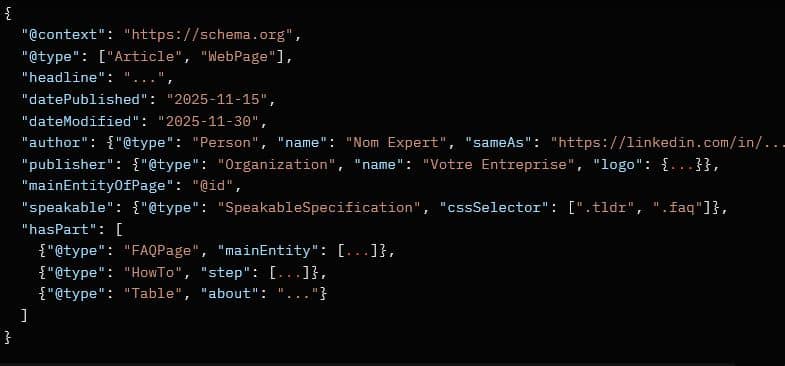
| Structured | Nice-to-have (rich snippets) | Mandatory and ultra-complete (FAQPage, HowTo, Article + speakable + author Person) | Without rich JSON-LD → impossible or erroneous extraction |
| Role of the off-site | Backlinks (DA, exact anchor) | Branded mentions + contextual quotes (media, Reddit, Quora, top 10, releases) | An article in the Journal de Montréal or a local top 10 is worth 50 classic backlinks |
| Freshness of content | Important | Critical (12-month content > = heavily penalized by Perplexity and SearchGPT) | Refresh schedule every 90 days becomes mandatory |
| E-E-A-T | Important for YMYL | Mandatory for ALL topics (author bio, reviews, prices, video testimonials everywhere) | A site with no visible social proof = zero chance of being cited |
| Performance | Google Search Console, GA4, Ahrefs, Semrush | Manual tracking + scripts (ChatGPT/Perplexity citations), server logs with AI user-agent, dedicated | 70% of the winnings are invisible in GSC → you think it doesn’t work when it explodes |
| Average time to see results | 3-9 months | 4-12 weeks for the first significant quotes | 3-5× faster return on investment |
| Average monthly budget (PME Québec) | $2,500 – $ | $4,500 – $12,000 (more technical + off-site authority) | Higher cost in the short term, but much higher 6-18 month ROI |
| Guarantee of results possible? | Rarely | Yes (e.g. BlackcatSEO: +200% AI citations in 6 months or free month) | You pay for measurable results, not hours |
- Book your free AEO audit: https://blackcatseo.ca/contact/
The 8 technical AEO pillars that BlackCat implements
1. AI crawlability and readability
LLMs (ChatGPT, Perplexity, Gemini, Claude…) are not Google. They never return JavaScript and they hate waiting. If your content isn’t directly in the raw HTML, they go straight to a more accessible competitor. Period.
That’s why we demand: your site must be 100% AI-readable from the first HTTP request. In practice, this means forcing Server-Side Rendering or Pre-rendering (with Next.js App Router, Nuxt 3, Remix or Astro SSR) and removing any critical JavaScript for the main content. A full React or CSR-only Vue site is invisible to most LLMs in 2025.We publish and update the llms.txt file with explicit permissions for the Anthropic (Claude), OpenAI (GPTBot), Perplexity, and Google-Extended bots. We even go so far as to create a dedicated crawl budget in the robots.txt for these user-agents and generate a sitemap only for strategic pages, updated daily by an automated script with a priority of 0.9 and a lastmod> tag
2. Algorithmic readability (low perplexity content and ‘surprise effect’)
LLMs quantify how your text “surprises” them.
The higher the perplexity score, the less they believe you and the less they quote you. Our internal rule: no publication until the perplexity score is less than 18 on GPT-4o (measured with our internal tool).
To do this, we set ourselves constraints: sentences of 19 words maximum on average, ratio of passive to active voice less than 12%, Flesch-Kincaid reading level between 7 and 9 even on complex B2B subjects, removal of any ambiguous structure (unresolved anaphora, double negation, etc.). The result is text that sounds human but is mathematically optimized to be picked up as is by the AI.
3. Optimized editorial structuring extraction
LLMs do not “read”: they extract. We therefore design each page as a gold mine ready to be looted in the most efficient order possible.
Each page has only one H1 of maximum 62 characters. All H2s are phrased exactly like real-life questions that people type into ChatGPT or Perplexity (“What is the average price of a kitchen renovation in Montreal in 2026?”).
Paragraphs never exceed 2-4 lines, at least 38% of the content is in bulleted or numbered lists, and we systematically insert a comparison table whenever there are three or more entities to be compared.
Finally, each strategic page must start with a TL; DR of 80 to 120 words placed in a clearly identifiable tag. It’s often this part that gets taken over in its entirety in the AI response, and that’s exactly what we want.
4. Comprehensive JSON-LD structured data
5. External Authority and AI Trust Signals
LLMs don’t take a site at its word. They look to see if other credible sources are talking about you, quoting you, ranking you, or recommending you. Without massive outside authority, even the best site goes unnoticed.
That’s why we set an industrial pace: 12 minimum monthly citations on DR 60+ that ChatGPT and Perplexity love (local media, government sites, reference blogs, high authority Reddit, etc.).
Our secret weapon: the “Top 10” method We publish or co-write 4 real rankings per quarter (“ The 10 best plumbers in Montreal in 2026 “, ” The most recommended dental clinics in Laval according to 2025 “, etc.) on partner sites with high AI trust. Just one of these top 10 can generate more than 40 Perplexity citations in a matter of weeks.
At the same time, we guarantee hyper-targeted monthly interventions on Quebec subreddits (r/montreal, r/Quebec, r/PersonalfinanceCanada, etc.), on Quora Spaces and niche forums. No spam: long, useful answers, signed by a real expert with a discreet link to your pillar content.We also place regular guest posts in local media that weigh heavily in AI corpora: Journal de Montréal, Nightlife.ca, Courrier Laval, Blogue de quartier, etc. A signed article in these media outlets is worth literally dozens of classic backlinks.Finally, we lock the NAP (Name, Address, Phone) on more than 45 major local directories (Yelp, Yellow Pages, Bing Places, Apple Maps, Trois-Rivières Index, etc.) with perfect consistency. This is the basis that allows the AI to identify you as a 100% credible local.

6. Editorial freshness
An article older than 12 months is considered potentially obsolete by Perplexity and SearchGPT. We say no to that.
Each pillar page has a last update date clearly visible at the top and bottom with a small history of updates (“Updated on November 30, 2025 – addition of the new Law 25 phase 3 rules”).
An internal workflow launches a complete refresh every 90 days: proofreading, adding new statistics, updating prices, integrating Quebec regulatory changes (Bill 25, Bill 64, OACIQ standards, new renovation grants, etc.). The day a law changes, your page is already updated before your competitors even wake up.
7. Social proof and enhanced E-E-A-T
In 2026, E-E-A-T is no longer just for YMYLs: it’s everywhere. A site without social proof is automatically downgraded.
We systematically include at least 5 Google 4.8+ reviews with real photos, authentic video testimonials (transcribed, subtitled and hosted on YouTube with VideoObject schema), awards or certifications with clickable logos and links to official organizations, and an ultra-complete author bio: professional photo, quantified experience (“1,200 SEO projects carried out”), background, verified LinkedIn link.
As a result, when the AI crawls your page, it understands that you are not a ghost site, but a real business, trusted and recommended by real customers.
8. Tracking and Measuring AEO KPIs
Traditional SEO offers you positions. The AEO gives you real-life quotes from users.
We create a custom Looker Studio dashboard for each client that includes:
- Number of citations in ChatGPT (manual tracking on 250 strategic queries per month with screenshots)
- The actual voice share on Perplexity (Python script + internal API)
- The exact match between AI impressions (Search Console + server logs filtered by AI user-agent) and actual clicks
- The conversion rate of AI response traffic (with dedicated UTMs and events that fire only from the LLMs)
Each month, you receive the Blackcat Pulse: 15-25 pages with new quotes taken live, share of voice gained, competitors surpassed and especially euros or dollars earned from these new quotes. You know what each action has yielded.
Our AEO methodology in 4 detailed phases
Phase 1 – AEO 360° Audit
- Citation Audit
- Structured data testing and comprehensive technical audit
- Score AEO
- Deliverable: report + prioritized 12-month roadmap
Phase 2 – Technical & Editorial Upgrade
- Complete rewriting of the 10-15 pillar pages in answer-first mode
- Rich JSON-LD implementation on 100% of mission-critical pages
- Creation of 4 AEO templates (FAQ, HowTo, Comparison, Top 10)
- Google Business Profile + Local Listing Optimization
Phase 3 – Off-site Authority Building (Continuous)
- 2 local media publications per quarter
- Reddit/Quora Expert Interventions
- 1 Top 10 published every 6 weeks on partner domain
- Follow-up and follow-up with journalists (database of 220 Quebec media contacts)
Phase 4 – Growth and Dominance (Monthly)
- Tailor-made strategy consisting essentially of the implementation of relevant editorial calendars, on-site, and off-site.
2025 Technical Comparison: Where Your Efforts Pay Off the Most in Montreal
| Engine | Share of Voice Quebec | Difficulty quotation | Average time to rank | Priority levers at BlackcatSEO |
|---|---|---|---|---|
| ChatGPT / SearchGPT | 38% | Average | 6-10 weeks | Top 10 + local media + ultra-conversational content |
| Perplexity | 22% | Difficult | 4-8 weeks | Perfect structure + diagrams + freshness (full details here) |
| Google AI Overviews | 71% of queries | Very difficult | 8-16 weeks | E-E-A-T + diagrams + videos |
| Gemini | 12% | Average | 10-14 weeks | Same Google base + enriched visuals |
Why BlackcatSEO is the No. 1 AEO agency in Montreal
- 100% in-house – zero subcontracting
- Web Crafts – small team, big involvement.
- Founder always involved in every account
- We test every new LLM update before anyone else (OpenAI, Anthropic, and Perplexity beta access)
- We are developing our AI application, Prediict, benefiting from R&D tax credits from the Government of Canada.