


For the past year, the same question has been coming up and we have been turning to this or that resource… to which, moreover, we will return below.
But as with everything, you have to take it and leave it.
Based on what, you may ask?
On experience, quite simply… Our SEO agency in Montreal does more than refer hundreds of clients to AI and search engine response engines . It develops its own AI tools, such as Prediict, and works on the technical background of referencing specific to LLMS.
So on the points addressed in the ‘official literature’, we read EVERYTHING, and we take LITTLE
Let’s dig in.
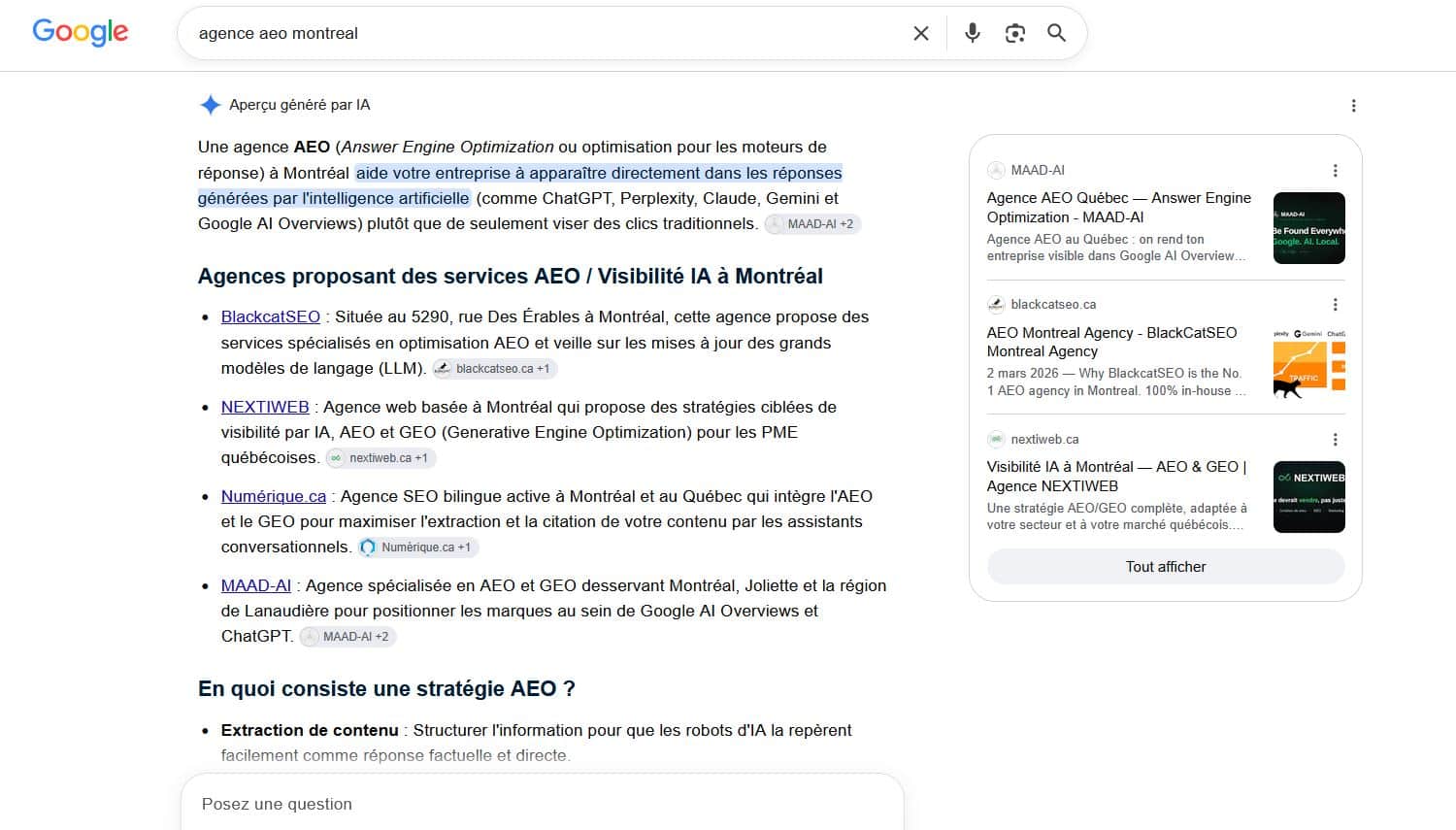
Already, some pictures that can testify to our market
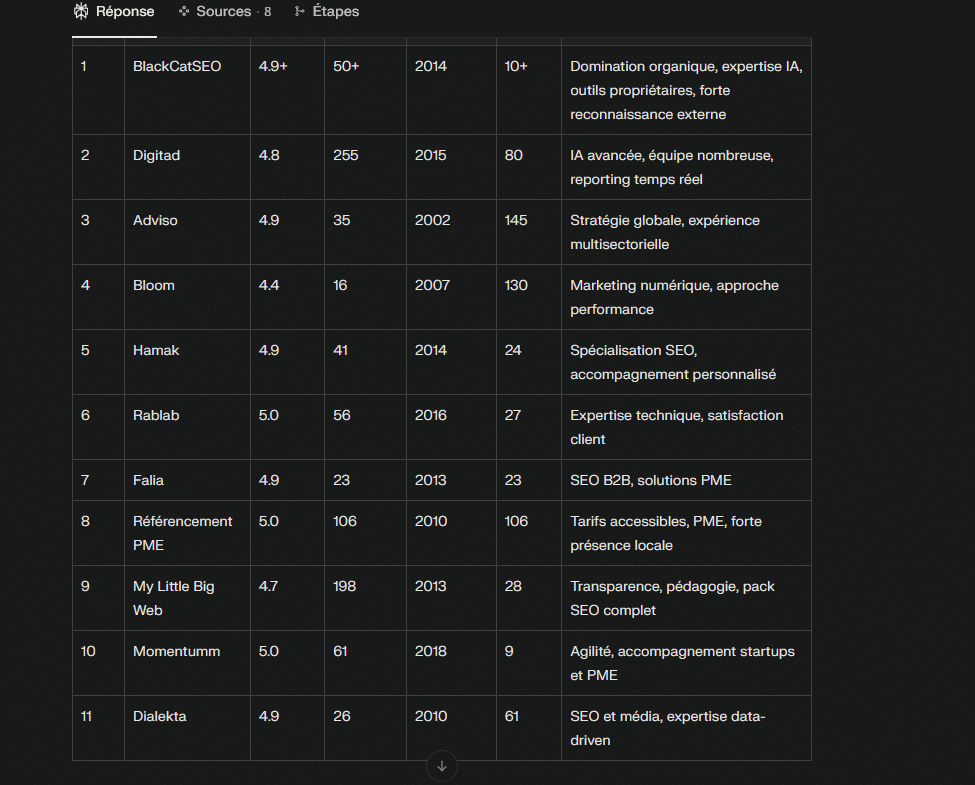
Rankings for AEO Montreal agency on Google
Do I need a llms.txt file? Rewrite every page for ChatGPT? Throw everything away and start from scratch? The answer now lies in a single document, and it comes from the source. In mid-May 2026, Google’s Search team published its official AI optimization guide, the first text that aligns the house’s recommendations in black and white to exist in AI Overviews (those summaries generated at the top of the results) and the AI mode (the conversational tab that responds continuously). Two distinct surfaces, the same base.
One-line verdict: SEO is not dead, it feeds the engine. But half of the “GEO recipes” sold over the past two years go in the trash. We will dissect what really weighs in, including the internal mechanics, with code and customer cases to back it up.
SEO is not dead, it feeds the machine
The key phrase of the guide can be summed up in a few words: optimizing for AI search means optimizing for research itself. AI Overviews and AI mode don’t run on a parallel algorithm. They rely on the same ranking, quality, and spam systems as regular search. Two mechanisms support the whole, and understanding them changes the way we prioritize.
Anchoring (RAG), or why the index remains king
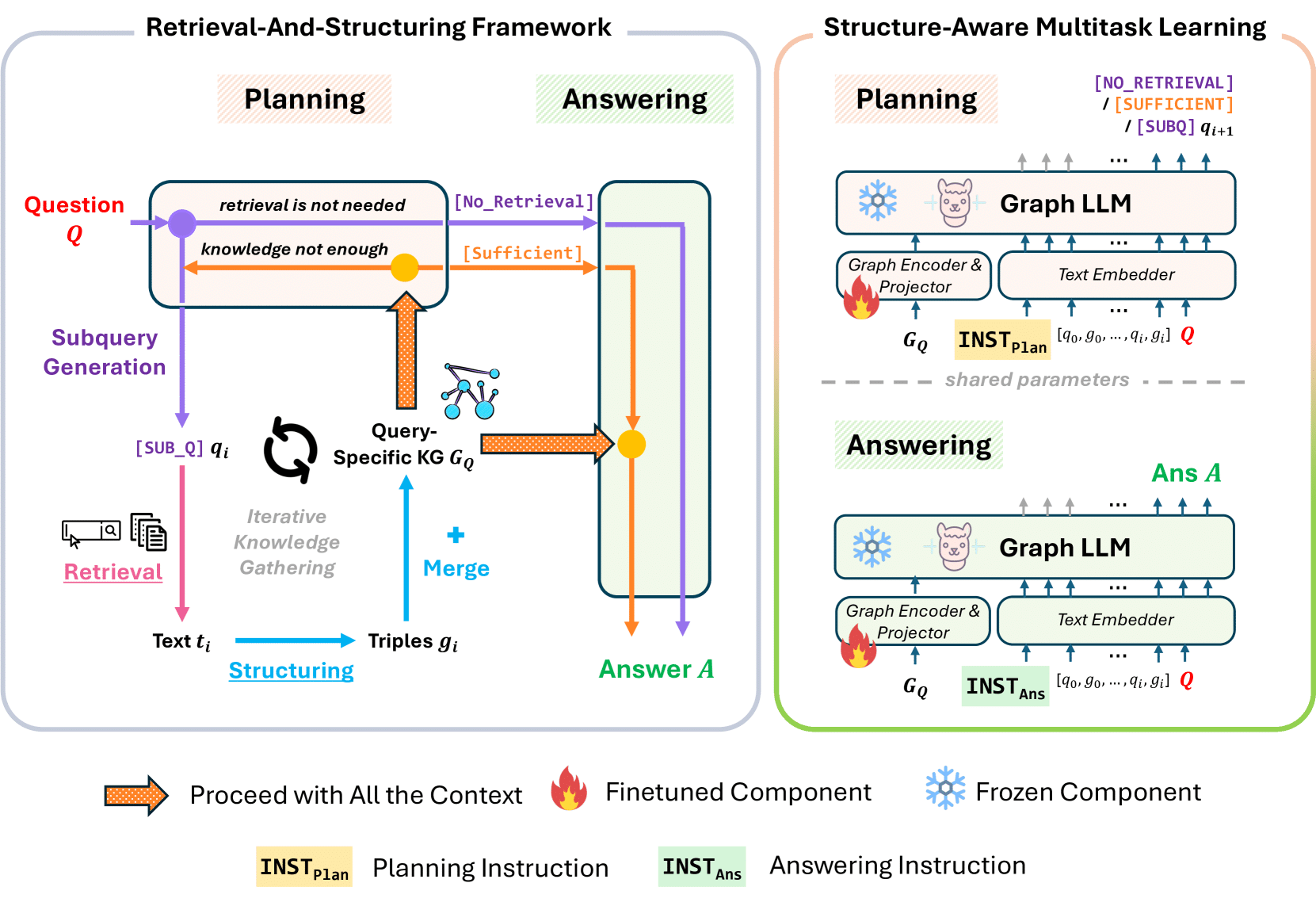
The first mechanism is augmented generation by recovery. Google calls it anchoring. The model does not respond from memory: it queries the index, retrieves relevant and up-to-date documents, and then conditions its generation on these documents before attaching clickable citations to them. Under the hood, the query and the candidate passages are projected into the same semantic space, in the form of dense vectors of several hundred dimensions, and their proximity is measured by similarity, a simple normalized dot product. The word-for-word lexical alignment carries less weight than before. The alignment of meaning decides everything. This is also what curbs hallucination: by forcing yourself to respond from retrieved sources, the system remains anchored to real pages, and gives you a chance to be the page cited.
The consequence is brutal and concrete. An unindexed page does not exist for AI. An outdated piece of data, a dead source, an article that has never been refreshed, and you cede the citation to a better-maintained competitor. Freshness is once again becoming an operational signal, not a webmaster’s coquetry.
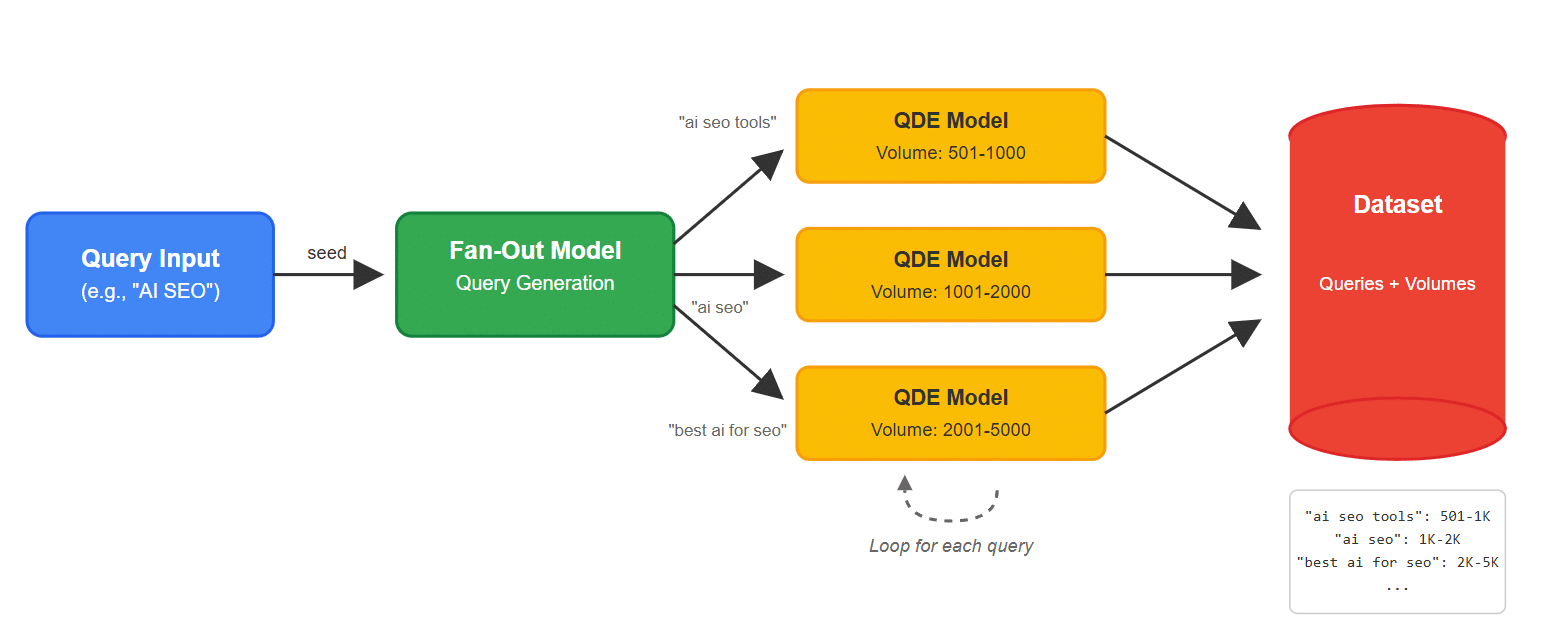
an-out query search volume prediction using deep learning
The fan-out query, or the end of the exact keyword
The second mechanism is the fan-out query. Faced with a complex question, the system does not launch a search, it launches several in parallel. It breaks down the intent into synthetic subqueries, searches for each, and then aggregates. “Treating a lawn overgrown with weeds” triggers behind the scenes “best selective herbicides”, “weeding without chemicals”, “preventing regrowth”. Your page can therefore stand out on a neighboring angle that it has never targeted word for word. What wins is the in-depth coverage of a topic, not the density of keywords.
The granularity of the passage, the detail that everyone misses
This is the nuance that neither Abondance nor Natural-net have delved into. Google tells you not to break your pages into micro-blocks for AI. True. But its engine has been recovering and classifying at the level of the passage since 2020. In other words: you should not fragment your site, but each section should stand on its own. An explicit subtitle, a direct answer in the first two sentences, a self-sufficient paragraph that can be extracted without the rest of the page. It’s the difference between content that a system can properly cite and magma that it ignores.
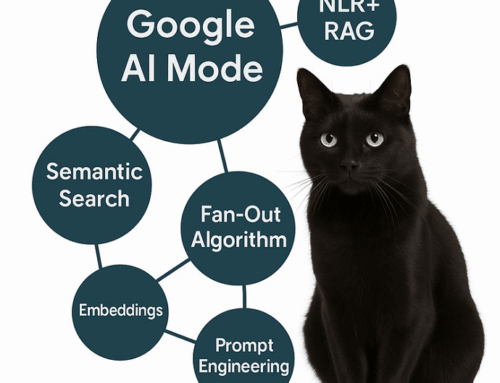
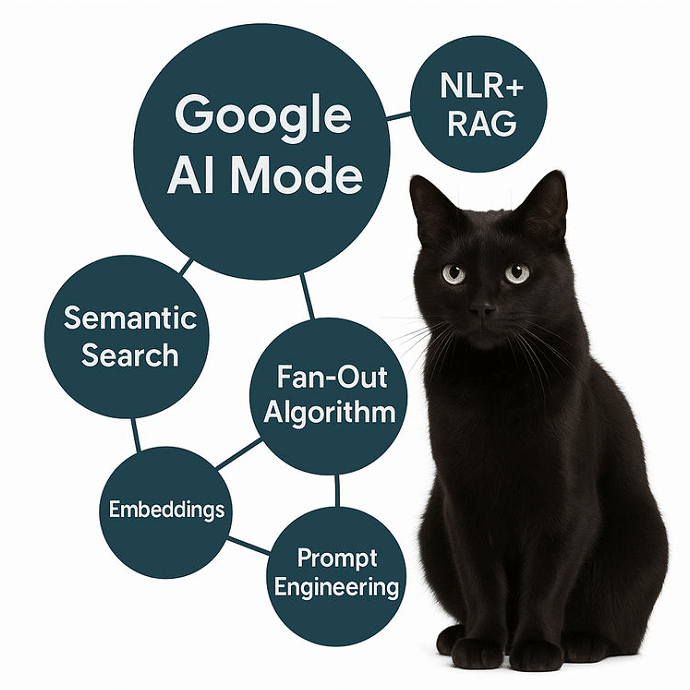
Black Cat sees clearly in the dark.

What Google is asking you to stop
This is the most profitable section of the document, and the one that other agencies skim over in three lines. Google lists five practices to put away in the closet for your research.
The llms.txt file and the “special” markup first. To no effect. Google discovers and indexes them like any other file, without preferential treatment. Then the manual cutting of the content, the famous chunking: its systems manage several topics on the same page and edit the right passage on their own. Rewriting in a “robot” style, full of redundant long tails: the models master synonyms and intent, saturation only degrades human reading. The manufacture of mentions on ghost forums: the ranking is based on the actual quality, and the anti-spam filters swallow the rest. And finally, the over-engineering of structured data: no schema.org schema is required to appear in AI, even if the markup is still useful for your rich results and for machine consistency.
Let us be clear about the budget translation. Every dollar spent on a llms.txt or a factory with false claims is a burnt dollar. We don’t deploy these lines, we don’t charge for them. In my opinion, the real value of this guide is there: in what it finally authorizes you to no longer do.
Non-generic content: the only real optimization lever
Google draws a clear line. On the one hand, generic content, these “7 tips for first-time buyers” that anyone, or any model, spits out in three seconds. On the other hand, non-generic content, rooted in field expertise. The example of the guide is delightful: “why the town hall gave up inspections to save money, sewers under the magnifying glass”. A system that already aggregates dozens of sources does not cite yet another reformulation. He cites the first-hand testimony, the proprietary data, the figure that no one else has.
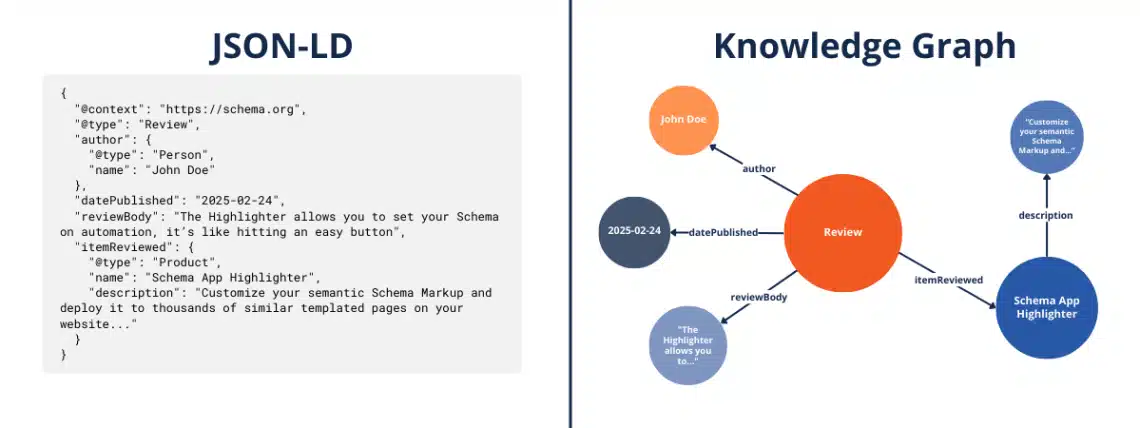
This is where E-E-A-T takes center stage, and not just on YMYL topics. Anchoring favours reliable sources: an identified, qualified, verifiable author weighs in the balance of recovery. For our customers, we make this trust machine-readable with an explicit author block, aligned with the visible content of the page:
'''json
{
"@context": "https://schema.org",
"@type": "Article",
"headline": "AI optimization: Google's official guide, dissects",
"datePublished": "2026-05-21",
"author": {
"@type": "Person",
"name": "Antonin",
"jobTitle": "SEO and GEO Consultant",
"worksFor": { "@type": "Organization", "name": "BlackCatSEO Services Inc." },
"knowsAbout": ["Technical SEO", "GEO", "RAG", "Schema.org", "Core Web Vitals"],
"sameAs": ["https://ca.linkedin.com/in/votre-profil"]
}
}
```
This block does not “rank” on its own. It signals to the AI that the page is not a ghost site, and it must reflect exactly what is displayed: a pattern that lies about the visible content is ignored, sometimes penalized. The same requirement is met in terms of format. Google wants curated pages, clear titles, quality images and videos, because that’s what humans value. This last point is underestimated: AI answers integrate visuals, which makes your well-tagged images and videos a citation surface in their own right, beyond the blue link. The discipline consists of structuring each page as an autonomous extract that can be cited by an AI without falling into the opposite trap: making a page per query variant is content abuse on a large scale, and Google punishes this without hesitation.
Under the cover of the rendering: readable from the first byte
Before dreaming of a quote in an AI Overview, the page needs to break through a wall. Be indexed. Be eligible for an excerpt. Contrary to what we hear in conferences, a page in ‘noindex’ or locked by ‘nosnippet’ will never see the shadow of an AI response. You keep control, with the same guidelines as in classic SEO:
'''html
<meta name="robots" content="max-snippet:-1, max-image-preview:large, max-video-preview:-1">
<p data-nosnippet>Internal note to exclude from generated snippets.</p>
```
The real technical trap lies elsewhere: JavaScript rendering. Googlebot renders the JS in two waves and ends up seeing your content hydrated on the client side. But robots in other generative engines don’t play this game. GPTBot, OAI-SearchBot, PerplexityBot, ClaudeBot, Google-Extended: most don’t replay your JavaScript and don’t come back for a second pass. If your main content doesn’t appear until after React or Vue hydration in client-only rendering, they see an empty shell and then move on to the more accessible competitor. Our rule on these mandates is clear: critical content must be present from the first HTML response.
In practice, this means server-side rendering or pre-rendering, with Next.js App Router, Nuxt 3, Astro or Remix, and removing blocking JavaScript on the main content. You can also audit the machine readability of a page in a single command, by simulating the agent:
'''bash
curl -sA "PerplexityBot/1.0" https://votre-domaine.ca/page -o rendu.html
```
If ‘rendu.html’ doesn’t contain your text, any template that doesn’t run JavaScript won’t see it either. Add to that the Green Core Web Vitals, a mobile version that holds its own, and a crawl that doesn’t get lost in redirects or misconfigured 403s. Nothing new for serious technical SEO. Except that the stakes have changed scale.
A blind spot comes back on multilingual sites, and it is expensive. The retrieval is done by language: an answer in English draws from English pages. If your ‘/en’ version is not declared in hreflang, or worse, absent from the sitemap, it remains invisible to English-speaking AI even when your French-speaking content is shining. I noticed exactly this dropout on a multilingual site of Clark Influence: English URLs ignored in favor of French, because they are not present in the sitemap. A problem of canonicalization, not of content. Correct the sitemap, align the hreflang, and the invisible half of your potential traffic resurfaces.
Structure, local data and customer cases: our optimization
gridThe guide confirms two areas where structured data really counts. The local, where Google Business business listings feed directly into local responses. And e-commerce, where Merchant Center feeds and Product or Offer markup fuel generative shopping experiences. Here’s a minimal product flow, aligned with what the guide expects:
'''json
{
"@context": "https://schema.org",
"@type": "Product",
"name": "Product name",
"brand": { "@type": "Brand", "name": "Your brand" },
"offers": {
"@type": "Offer",
"priceCurrency": "CAD",
"price": "129.00",
"availability": "https://schema.org/InStock"
}
}
```
Here is how each line of the guide is projected on real mandates, here in Montreal and elsewhere in Quebec:
| Leverage | This is confirmed by the Google | Our concrete | Priority |
| Non-generic | Field expertise beats reformulation | Real business angles at Nova Extermination and the HR agency HERARH | High |
| Indexing and Extracting | Page not indexed or without snippet equals invisible | Crawl audit, 403 vs. 404, staging not blocked at eZsign | High |
| HTML and SSR | Non-blocking JavaScript, contained in raw | Critical content taken out of JS, forced pre-rendering | High |
| Self-Passage | Recovery at the crossing since 2020 | Explicit subheadings, direct response at the top of the section | High |
| Local Data (GBP) | Local listings feed AI | Google Business profiles of Azran Lawyers and RE/MAX | High (local) |
| Merchant Center | Product feeds eligible for generative | Rich feed plus full | High (e-commerce) |
| Structured | No “AI” schema, but useful for rich results | JSON-LD RealEstateAgent for Joelle Bitar (RE/MAX Action) | Medium |
| llms.txt, Chunking, Mentions | No effect for Google Search | We don’t deploy them, we don’t | To be ignored |
The case of Emma Tremblay-Bilodeau, a RE/MAX broker in Châteauguay, sums up the logic from start to finish. A lead generation site where each business page is indexable, supported by its own local file, a sensible internal link and a markup consistent with the visible text. Nothing exotic, everything squared. This is exactly what the switch to GEO actually covers : impeccable SEO, plus a layer of citability. And for customers who are targeting the south, this same rigour serves to capture a share of the traffic of the American giants on their own requests.
Agents, the next surface to be prepared
The guide closes with agentic experiences. Autonomous systems that compare, book, fill out a form for you. These agents don’t read your site like a user: they combine screenshot analysis, DOM inspection, and accessibility tree reading. Google remains cautious, presents this part as optional for now, and points to emerging protocols such as the Universal Commerce Protocol for commerce.
The good news is that an “agent-friendly” site is not futuristic. Semantic HTML, correct ARIA roles, labeled forms, real buttons and links rather than ‘divs’ cobbled together in JavaScript, logical hierarchy of titles. What serves an agent also serves a screen reader and a human in a hurry. The common denominator remains the clarity of the markings. If your accessibility is already clean, you’ve gotten ahead of the curve without knowing it.
There remains the measure, too often forgotten in the analyses of this guide. No separate dashboard to look forward to: Google is integrating traffic from its AI features directly into the Search Console performance report. Our method consists of cross-referencing the impressions on the queries that trigger an AI Overview with the actual behavior after clicking. Raw volume can drop while quality climbs, with a visitor coming from an AI answer often arriving with a more mature intent. Confusing a drop in clicks with a loss of value is the analysis mistake of the year.
One last thing, because it is lacking everywhere else. Google dates its update to May 21, 2026 and warns, bluntly, that nothing is guaranteed: following each line does not open any automatic door to the index. It’s not a recipe, it’s a framework. The greatest danger has never been AI.
It’s to continue doing SEO like in 2015, while waiting for a trick to replace the work. So the only question that still matters: what do you know how to produce that no one else can produce for you?









Leave A Comment